R.K.Narayana
- Textual Grammar:
- Summary of the short story: An Astrologer’s Day
- Meanings and Short Questions: An Astrologer’s Day
- Check your progress
- A. Choose the correct alternative :
- B. The story contains synonyms of the expressions given below. Locate them in the text and write them down:
- C. Read the story carefully and find single words for each of the phrases given below:
- D. The story contains the antonyms of the words given below. Locate them in the text and write them down.
- E. Answer the following questions :
- Answers to check your progress
Textual Grammar:
Summary of the short story: An Astrologer’s Day
The story is about an astrologer who uses trickery to make a living.
The story takes place in a busy marketplace in a small town in India. The main character is an astrologer who sets up a temporary stall every day to read people’s horoscopes and make astrological predictions. He attracts different clients, from curious spectators to genuine believers in astrology.
The astrologer tricks a man named Guru Nayak by making a false prediction about his enemy who wanted to kill him, as already dead. Later, the astrologer convinces him to return home by saying he is in danger, and Guru Nayak thanks the astrologer and leaves. The astrologer realizes that Guru Nayak was actually his victim from years ago and feels relieved. This recognition had also enabled him to assume the role of a genuine astrologer for one night and speak with the air of an oracle. He had thougt that Guru Nayak, whom he had attacked with a knife, was dead and had carried the guilt of the assumed murder with him. In the end, the astrologer finds closure and his wife plans to buy sweets with the coins he earned.
The Appearance and Business of the Astrologer
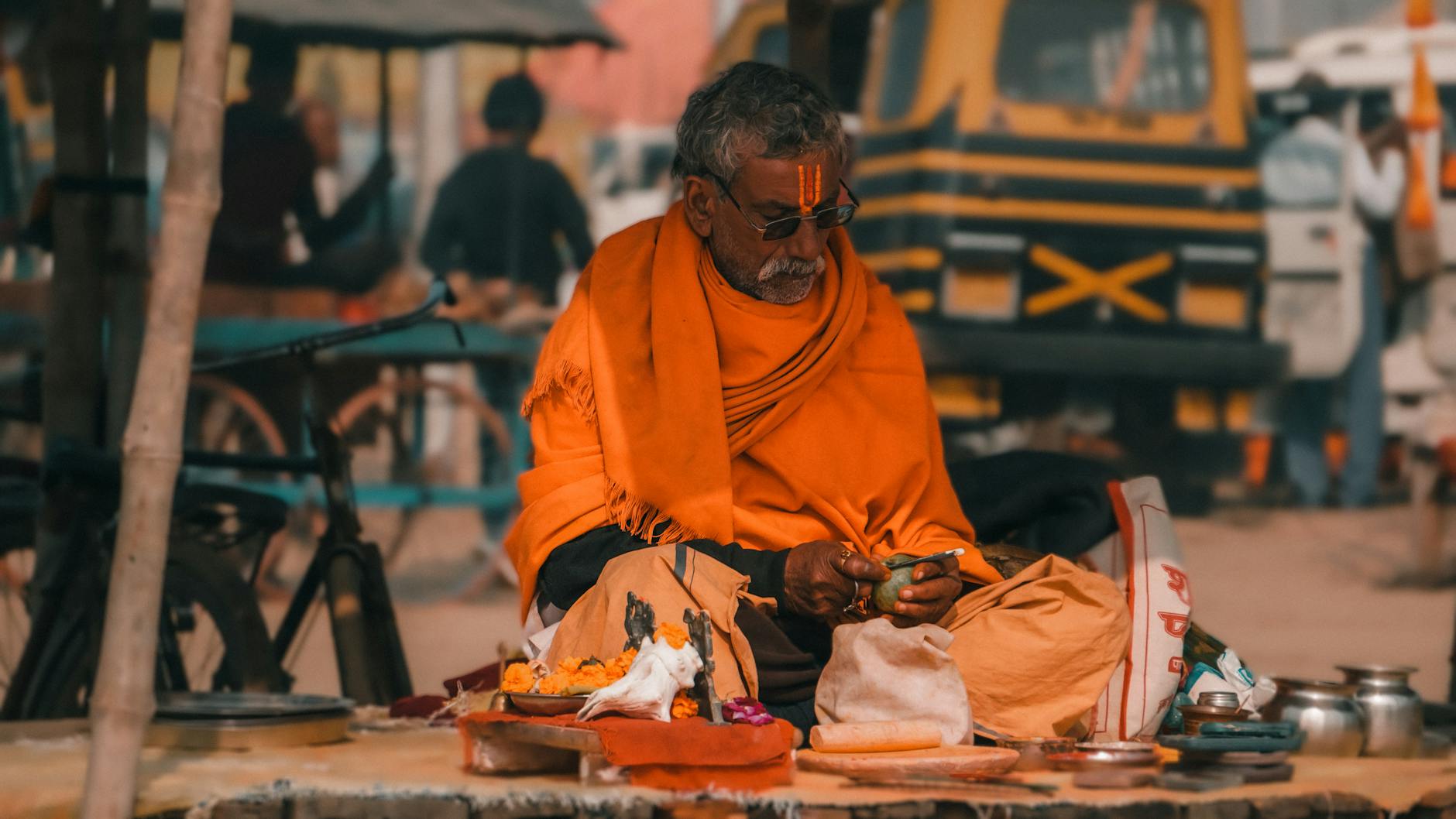
The astrologer had a shining forehead with sacred ash and vermilion. His eyes sparkled as he looked for customers. He wore a saffron-colored turban. People were drawn to him like bees to flowers.
Every day at mid-day, the astrologer would begin his business. He would open his bag and lay out his professional tools, which included sea shells, a cloth with mystic charts, a notebook, and a bundle of Palmyra writing.
The Astrologer’s Ability to Understand Human Problems
The astrologer knew nothing about the stars, yet he spoke in a way that pleased and surprised everyone. It was a result of studying and practicing. He had a remarkable ability to understand human troubles such as marriage and money. Due to his extensive experience, he could identify problems within five minutes, earning the wages he deserved.
The Astrologer’s Encounter with His Enemy
At the end of the day, as the astrologer was packing up, he noticed a man. He told the man he looked worried and invited him to sit and talk. It turned out to be the person the astrologer had tried to kill in his youth. The astrologer felt challenged when the man asked him to share something important. When the match was lit, the astrologer saw the man’s face and felt very uncomfortable. The astrologer tried to leave, but the man stopped him and slapped him, saying:Challenge is Challenge, Go on.
The astrologer told the man that he had died four months ago and warned him of a danger if he left his house. The man learned that his enemy had died by being crushed under a lorry. Then the astrologer went home and gave all the money he earned to his wife, feeling relieved from a great tension. He explained to her that he had been running away from the guilt of killing a man for years.
Meanings and Short Questions: An Astrologer’s Day
Punctually at midday he opened his bag and spread out his professional equipment,
which consisted of a dozen cowrie shells, a square piece of cloth with obscure mystic
charts on it, a notebook, and a bundle of palmyra writing. His forehead was
resplendent with sacred ash and vermilion, and his eyes sparkled with a sharp,
abnormal gleam which was really an outcome of a continual searching look for
customers, but which his simple clients took to be a prophetic light and felt comforted.
- Cowrie shells (শঙ্খচূর্ণ) – Small shells used historically as a form of currency or for divination purposes.
- Mystic (রহস্যময়) – Relating to mysteries or mystical experiences; spiritual or occult.
- Obscure (অস্পষ্ট) – Not well-known or unclear.
- Vermilion (সিঁদুর) – A bright red pigment often used in religious ceremonies.
- Resplendent (প্রদীপ্ত) – Shining brightly; splendid or magnificent.
- Prophetic (ভবিষ্যদ্বাণীমূলক) – Relating to or characteristic of a prophet or prophecy.
- What did the astrologer spread out at midday from his bag?
- Answer: The astrologer spread out his professional equipment, which included a dozen cowrie shells, a square piece of cloth with obscure mystic charts on it, a notebook, and a bundle of palmyra writing.
- How did the astrologer’s clients perceive the gleam in his eyes?
- Answer: The astrologer’s clients perceived the gleam in his eyes as a prophetic light and felt comforted by it, although it was actually an outcome of his continual searching look for customers.
The power of his eyes was considerably enhanced by their position—placed as they
were between the painted forehead and the dark whiskers which streamed down his
cheeks: even a half-wit’s eyes would sparkle in such a setting. To crown the effect he
wound a saffron-colored turban around his head. This color scheme never failed.
- Enhanced (বৃদ্ধি পাওয়া) – Increased or improved.
- Whiskers (দাড়ি) – The stiff hairs that grow on a man’s face, typically on the cheeks and chin.
- Saffron-colored (জফরানি রঙের) – Having the color of saffron, which is a deep orange-yellow color.
- Turban (পাগড়ি) – A long piece of cloth wrapped around the head, worn especially by Sikh and Muslim men.
How did the astrologer enhance the power of his eyes according to the passage?
- Answer: The astrologer enhanced the power of his eyes by positioning them between his painted forehead and dark whiskers, and by wearing a saffron-colored turban, which created a striking color scheme.
People were attracted to him as bees are attracted to cosmos or dahlia stalks. He sat
under the boughs of a spreading tamarind tree which flanked a path running through
the town hall park. It was a remarkable place in many ways: a surging crowd was
always moving up and down this narrow road morning till night. A variety of trades and
occupations was represented all along its way: medicine sellers, sellers of stolen
hardware and junk, magicians, and, above all, an auctioneer of cheap cloth, who
created enough din all day to attract the whole town. Next to him in vociferousness
came a vendor of fried groundnut, who gave his ware a fancy name each day, calling it
“Bombay Ice Cream” one day, and on the next “Delhi Almond,” and on the third “Raja’s
Delicacy,” and so on and so forth, and people flocked to him. A considerable portion of
this crowd dallied before the astrologer too. The astrologer transacted his business by
the light of a flare which crackled and smoked up above the groundnut heap nearby.
- Cosmos (কসমোস) – A type of flower with a bright, daisy-like appearance.
- Dahlia (ডেলিয়া) – Another type of flower known for its colorful blooms.
- Boughs (শাখা) – The main branches of a tree.
- Tamarind tree (তেঁতুল গাছ) – A tropical tree that produces pods containing a sour pulp used in cooking and beverages.
- Surging (প্রবাহিত ) – Moving in a powerful, swelling motion.
- Occupations (পেশা) – Jobs or professions.
- Junk (বেকার পণ্য) – Old or discarded items that are considered worthless or of little value.
- Flanked (পাশে থাকা) – Positioned on either side of something.
- Vociferousness (উচ্চস্বরের অভিযোগমূলক স্বরের গুণবিশেষ) – The quality of being loud and outspoken.
- Dallied (সময় অপচয় করা) – Spent time idly or in a leisurely manner.
Why did a considerable portion of the crowd stop before the astrologer?
Answer: A considerable portion of the crowd stopped before the astrologer because they were attracted to him, much like bees are attracted to flowers, and because he transacted his business under the light of a flare near the groundnut heap, which created an inviting atmosphere.
Half the enchantment of the place was due to the fact that it did not have the benefit of
municipal lighting. The place was lit up by shop lights. One or two had hissing
gaslights, some had naked flares stuck on poles, some were lit up by old cycle lamps,
and one or two, like the astrologer’s, managed without lights of their own. It was a
bewildering crisscross of light rays and moving shadows. This suited the astrologer
very well, for the simple reason that he had not in the least intended to be an
astrologer when he began life; and he knew no more of what was going to happen to
others than he knew what was going to happen to himself next minute. He was as
much a stranger to the stars as were his innocent customers. Yet he said things which
pleased and astonished everyone: that was more a matter of study, practice, and
shrewd guesswork. All the same, it was as much an honest man’s labor as any other,
and he deserved the wages he carried home at the end of a day.
- Enchantment (মোহমায়া) – A feeling of great pleasure or delight; a magical quality or charm.
- Municipal (পৌরসভার) – Relating to a municipality or local government.
- Hissing (শ্বস্তিমার্জন) – Making a sharp, sibilant sound like that of air escaping under pressure.
- Flares – bright, flickering lights.
- Crisscross – Forming a pattern of intersecting lines or paths crossing each other.
- Shrewd (বিচক্ষণ) – Having or showing sharp powers of judgment; astute.
- Guesswork (অনুমান) – The process of forming an opinion or estimate without sufficient evidence or knowledge.
Why did the astrologer’s lack of knowledge about astrology not hinder his success in pleasing and astonishing his customers?
The astrologer’s lack of knowledge about astrology did not hinder his success in pleasing and astonishing his customers because he relied on study, practice, and shrewd guesswork to say things that pleased them. Despite knowing as much about the stars as his innocent customers, he managed to impress them with his predictions, which were based more on observation and intuition rather than actual astrological knowledge. Thus, his ability to satisfy his customers was not dependent on his expertise in astrology but on his skill in understanding human nature and making convincing guesses.
He had left his village without any previous thought or plan. If he had continued there
he would have carried on the work of his forefathers—namely, tilling the land, living,
marrying, and ripening in his cornfield and ancestral home. But that was not to be. He
had to leave home without telling anyone, and he could not rest till he left it behind a
couple of hundred miles. To a villager it is a great deal, as if an ocean flowed between.
- Ripening (পরিপক্ব) – Maturing or becoming ready for harvest.
- Ancestral (পূর্বপুরুষগণের) – Relating to or inherited from one’s ancestors.
- Forefathers (পূর্বপুরুষ) – Ancestors; predecessors in a family or lineage.
- Tilling (খেতাবাড়ি করা) – Cultivating or preparing land for crops by plowing, harrowing, and raising plants.
- Villager (গ্রামবাসী) – A person who lives in a village.
Why did the astrologer leave his village without informing anyone?
The astrologer left his village without informing anyone because he felt compelled to do so. He had a strong urge to leave home behind, and he couldn’t rest until he had traveled a couple of hundred miles away. To him, this distance felt significant, akin to crossing an ocean. He left behind the traditional life of his forefathers, which involved farming, living, marrying, and settling in his ancestral home.
He had a working analysis of mankind’s troubles: marriage, money, and the tangles of
human ties. Long practice had sharpened his perception. Within five minutes he
understood what was wrong. He charged three paise8 per question, never opened his
mouth till the other had spoken for at least ten minutes, which provided him enough
stuff for a dozen answers and advices. When he told the person before him, gazing at
his palm, “In many ways you are not getting the results for your efforts,” nine out of ten
were disposed to agree with him. Or he questioned: “Is there any woman in your
family, maybe even a distant relative, who is not well disposed towards you?” Or he
gave an analysis of character: “Most of your troubles are due to your nature. How can
you be otherwise with Saturn where he is? You have an impetuous nature and a rough
exterior.” This endeared him to their hearts immediately, for even the mildest of us
loves to think that he has a forbidding exterior.
- Analysis (বিশ্লেষণ) – Examination of something in detail to understand its nature or structure.
- Perception (ধারণা) – The ability to see, hear, or become aware of something through the senses.
- Advices (পরামর্শ) – Suggestions or recommendations given to someone about what they should do.
- Impetuous (তাড়াতাড়ি এবং চিন্তা বা যত্ন ছাড়া করা) – Acting or done quickly and without thought or care.
- Exterior (বহিরাংশ) – The outer surface or appearance of something.
What were some of the common topics of questions or analysis that the astrologer addressed for his clients?
The astrologer addressed common topics such as marriage, money, and the complexities of human relationships for his clients. He would often inquire about family dynamics, analyze character traits, and make observations about the difficulties individuals faced in their lives.
The nuts vendor blew out his flare and rose to go home. This was a signal for the
astrologer to bundle up too, since it left him in darkness except for a little shaft of green
light which strayed in from somewhere and touched the ground before him. He picked
up his cowrie shells and paraphernalia and was putting them back into his bag when
the green shaft of light was blotted out; he looked up and saw a man standing before
him. He sensed a possible client and said, “You look so careworn. It will do you good
to sit down for a while and chat with me.” The other grumbled some reply vaguely. The
astrologer pressed his invitation; whereupon the other thrust his palm under his nose,
saying, “You call yourself an astrologer?” The astrologer felt challenged and said, tilting
the other’s palm towards the green shaft of light, “Yours is a nature …” “Oh, stop that,”
the other said. “Tell me something worthwhile….”
- Paraphernalia (উপকরণ, সরঞ্জাম) – Equipment or items used for a particular activity or task.
- Careworn (চিন্তামগ্ন) – Showing the signs of worry or stress; weary or tired-looking.
- Grumbled ( বকবক করা)- Complained or muttered discontentedly.
- Vaguely (অস্পষ্টভাবে) – In a way that is not clearly or precisely expressed; indistinctly.
- Challenged (প্রতিষ্ঠিত) – Put to the test in a way that demands courage, resourcefulness, or skill.
- Thrust (ধাক্কা) – Pushed forcefully or abruptly.
What was the astrologer’s reaction when the man challenged his profession?
When the man challenged the astrologer’s profession, the astrologer felt challenged and attempted to begin his usual palm reading routine. However, the man interrupted him, expressing a desire for something more substantial or worthwhile than the usual vague predictions.
Our friend felt piqued. “I charge only three paise per question, and what you get ought
to be good enough for your money….” At this the other withdrew his arm, took out an
anna, and flung it out to him, saying, “I have some questions to ask. If I prove you are
bluffing, you must return that anna to me with interest.”
“If you find my answers satisfactory, will you give me five rupees?”
“No.”
“Or will you give me eight annas?”
- Piqued (বিরক্ত) – Offended or irritated.
- Bluffing (ধামার চেষ্টা করা) – Attempting to deceive or mislead through a show of confidence or strength.
- Anna (আনা) – A former Indian coin, worth one-sixteenth of a rupee.
- Satisfactory (সন্তোষজনক) – Meeting or fulfilling expectations or requirements.
- Interest (সুদ) – A sum paid or charged for the use of money lent or borrowed.
What was the man’s response when the astrologer asked if he would give him five rupees or eight annas if he found his answers satisfactory?
The man responded negatively to the astrologer’s proposal. He refused to give five rupees or eight annas even if he found the astrologer’s answers satisfactory.
“All right, provided you give me twice as much if you are wrong,” said the stranger. This
pact was accepted after a little further argument. The astrologer sent up a prayer to
heaven as the other lit a cheroot. The astrologer caught a glimpse of his face by the
match light. There was a pause as cars hooted on the road, jutka drivers swore at their
horses, and the babble of the crowd agitated the semidarkness of the park. The other
sat down, sucking his cheroot, puffing out, sat there ruthlessly. The astrologer felt very
uncomfortable. “Here, take your anna back. I am not used to such challenges. It is late
for me today….”
- Cheroot (চিরুট) – A thin cigar with both ends clipped straight.
- Agitated (উত্তেজিত) – Disturbed or excited.
- Semidarkness (অর্ধ-অন্ধকার) – Partial darkness.
- Ruthlessly (নির্মম) – Without pity or compassion; cruelly or mercilessly.
Why did the astrologer feel uncomfortable and offer to return the anna to the stranger?
The astrologer felt uncomfortable because he was not accustomed to such challenges. The presence of the stranger and the pressure of the bet made him uneasy, prompting him to offer to return the anna to the stranger.
He made preparations to bundle up. The other held his wrist and said, “You can’t get
out of it now. You dragged me in while I was passing.” The astrologer shivered in his
grip; and his voice shook and became faint. “Leave me today. I will speak to you
tomorrow.” The other thrust his palm in his face and said, “Challenge is challenge. Go
on.” The astrologer proceeded with his throat drying up, “There is a woman …”
- Grip (আঁকড়ে ধরে) – A firm hold or grasp, especially with the hand.
- Shivered (কম্পিত) – Shook or trembled involuntarily, typically as a result of fear or cold.
- Faint (ক্ষীণ) – Weak or feeble.
- Thrust (ধাক্কা) – Pushed forcefully or abruptly.
What was the stranger’s response when the astrologer asked to be left alone for the day?
The stranger insisted that the astrologer couldn’t back out of their agreement, stating that the challenge had been initiated by the astrologer himself. He compelled the astrologer to continue with the palm reading despite the astrologer’s reluctance.
“Stop,” said the other “I don’t want all that. Shall I succeed in my present search or
not? Answer this and go. Otherwise I will not let you go till you disgorge all your coins.”
The astrologer muttered a few incantations and replied, “All right. I will speak. But will
you give me a rupee if what I say is convincing? Otherwise I will not open my mouth,
and you may do what you like.” After a good deal of haggling the other agreed. The
astrologer said, “You were left for dead. Am I right?”
“Ah, tell me more.”
“A knife has passed through you once?” said the astrologer.
“Good fellow!” He bared his chest to show the scar. “What else?”
“And then you were pushed into a well nearby in the field. You were left for dead.”
“I should have been dead if some passerby had not chanced to peep into the well,”
exclaimed the other, overwhelmed by enthusiasm. “When shall I get at him?” he asked,
clenching his fist.
- Incantations (মন্ত্র) – Ritual recitations or chants believed to have magical or supernatural effects.
- Convincing (বিশ্বাসযোগ্য) – Able to persuade or satisfy someone that something is true.
- Haggling (কোলাহল) – Negotiating or arguing over the terms of a deal.
- Bared (উপস্থিত করা) – Revealed or exposed.
- Enthusiasm (উদ্দীপন) – Intense excitement or eagerness.
What was the condition set by the astrologer before he revealed the information about the stranger’s past?
The condition set by the astrologer before he revealed the information about the stranger’s past was that the stranger would give him a rupee if what he said was convincing. If not, the astrologer wouldn’t speak, and the stranger could do as he pleased.
“In the next world,” answered the astrologer. “He died four months ago in a far-off
town. You will never see any more of him.” The other groaned on hearing it. The
astrologer proceeded:
“Guru Nayak—”
“You know my name!” the other said, taken aback.
“As I know all other things. Guru Nayak, listen carefully to what I have to say. Your
village is two days’ journey due north of this town. Take the next train and be gone. I
see once again great danger to your life if you go from home.” He took out a pinch of
sacred ash and held it to him. “Rub it on your forehead and go home. Never travel
southward again, and you will live to be a hundred.”
- Groaned (বিতঙ্কিত করা) – Made a low, mournful sound expressing pain, discomfort, or unhappiness.
- Taken aback (অবাক হত্তয়া) – Surprised or shocked.
- Sacred (পবিত্র) – Connected with religious or spiritual beliefs; considered holy or divine.
What advice did the astrologer give to Guru Nayak, and what did he instruct him to do with the sacred ash?
The astrologer advised Guru Nayak to return to his village immediately and never travel southward again. He instructed him to take the next train and apply the sacred ash on his forehead before departing. He also predicted that if Guru Nayak followed these instructions, he would live to be a hundred years old.
“Why should I leave home again?” the other said reflectively. “I was only going away
now and then to look for him and to choke out his life if I met him.” He shook his head
regretfully. “He has escaped my hands. I hope at least he died as he deserved.” “Yes,”
said the astrologer. “He was crushed under a lorry.” The other looked gratified to hear
it.
The place was deserted by the time the astrologer picked up his articles and put them
into his bag. The green shaft was also gone, leaving the place in darkness and silence.
The stranger had gone off into the night, after giving the astrologer a handful of coins.
- Reflectively (আত্মবিচারে) – In a thoughtful or contemplative manner.
- Regretfully (অনুতাপে) – With a feeling of sadness or disappointment over something that has happened or been done.
- Gratified (সন্তুষ্ট) – Pleased or satisfied.
- How did the astrologer and the stranger part ways at the end of the encounter?
At the end of the encounter, the stranger went off into the night after giving the astrologer a handful of coins. The astrologer picked up his articles and put them into his bag, and the place became deserted, enveloped in darkness and silence.
It was nearly midnight when the astrologer reached home. His wife was waiting for him
at the door and demanded an explanation. He flung the coins at her and said, “Count
them. One man gave all that.”
“Twelve and a half annas,” she said, counting. She was overjoyed. “I can buy some
jaggery and coconut tomorrow. The child has been asking for sweets for so many days
now. I will prepare some nice stuff for her.” “The swine has cheated me! He promised
me a rupee,” said the astrologer. She looked up at him. “You look worried. What is
wrong?”
“Nothing.”
- Explanation (ব্যাখ্যা) – A statement or account that makes something clear or understandable.
- Flung (ছুড়ে দেওয়া) – Threw or tossed forcefully.
- Overjoyed (অত্যন্ত আনন্দিত) – Extremely happy or delighted.
- Jaggery (গুড়) – A type of unrefined sugar made from sugarcane juice.
- Coconut (নারিকেল) – The large, brown, hard-shelled fruit of the coconut palm.
- Swine (শূকর) – A pig; a contemptuous term for a person considered morally reprehensible or disgusting.
How did the astrologer’s wife react when he flung the coins at her and what did she plan to do with the money?
The astrologer’s wife was overjoyed when he flung the coins at her. After counting them, she found out that there were twelve and a half annas. She planned to use the money to buy jaggery and coconut the next day so she could prepare some sweets for their child, who had been asking for them for many days.
After dinner, sitting on the pyol, he told her, “Do you know a great load is gone from me
today? I thought I had the blood of a man on my hands all these years. That was the
reason why I ran away from home, settled here, and married you. He is alive.”
She gasped. “You tried to kill!”
“Yes, in our village, when I was a silly youngster. We drank, gambled, and quarreled
badly one day—why think of it now? Time to sleep,” he said, yawning, and stretched
himself on the pyol.
- Pyol (পীয়ল) – A raised platform or veranda outside a house, often used for sitting.
- Gasped (হাঁসফাঁস) – Inhaled suddenly with a wide open mouth, usually due to surprise, shock, or difficulty breathing.
- Gambled (জুয়া) – Played games of chance for money; took risky actions in the hope of a desired result.
- Quarreled (ঝগড়া) – Had a heated argument or disagreement.
Why did the astrologer feel relieved and share his past with his wife after dinner?
The astrologer felt relieved and shared his past with his wife after dinner because he realized that the person he had thought he had killed many years ago was actually alive. This revelation lifted a great burden from him, as he had carried the guilt of this incident for years, prompting him to run away from home and start a new life.
Check your progress
A. Choose the correct alternative :
- From the twelve and a half annas that the astrologer earned, his
wife planned to
a. Buy fruits b. Buy vegetables c. Make sweets - To answer his questions, the man first gave the astrologer
a. Three pies b. Four pies c. Five pies - The astrologer was able to please customers because of
a. His humor b. His honesty c. His clever guessing
B. The story contains synonyms of the expressions given
below. Locate them in the text and write them down:
- Bright red in color
- Expressing opinions or feelings in a loud and confident way
- Willing or prepared to do something
- Words that are spoken or sung to have a magical effect
- With no people in it
C. Read the story carefully and find single words for each of
the phrases given below:
Bright and colorful in an impressive way
- To hang about aimlessly
- Showing good judgement and likely to be right
- Acting without thinking of results
- A large number of objects or personal possessions
D. The story contains the antonyms of the words given below.
Locate them in the text and write them down.
- Amateur
- Unremarkable
- Guilty
- Interior
- Safety
E. Answer the following questions :
- When did the astrologer usually start his day’s business?
- Why did the astrologer think he had committed a murder?
- What mark did Guru Nayak have on his chest?
- How much money did the astrologer usually charge per
question? - What made the astrologer’s forehead look grand?
- How did the astrologer know the name of his customer?
- Describe the place where the astrologer set up his daily
business.
Answers to check your progress
A. Choose the correct alternative :
- – C
R. K. Narayan’s ‘An Astrologer’s Day’ / 249 - What made the astrologer’s forehead look grand?
- How did the astrologer know the name of his customer?
- Describe the place where the astrologer set up his daily
business. - – A
- – C
B. The story contains synonyms of the expressions given
below. Locate them in the text and write them down : - Vermilion
- Vociferousness
- Dallied
- Incantations
- Deserted
C. Read the story carefully and find single words for each of the
phrases given below : - Resplendent
- Surging
- Shrewd
- Impetuous
- Paraphernalia
D. The story contains the antonyms of the words given below.
Locate them in the text and write them down. - Professional
- Remarkable
- Proud
- Exterior
- Dangerous
E. Answer the following questions: - Punctually at midday the astrologer usually started his day’s
business. - The astrologer had a fight with Guru Nayak and had thrown him in
a well and he supposed him to be dead. So the astrologer thought
he had committed the murder of Guru Nayak.
R. K. Narayan’s ‘An Astrologer’s Day’ / 250 - Guru Nayak had a mark of injury of knife on his chest.
- The astrologer usually charged three pies per question.
- The astrologer’s forehead was resplendent with sacred ash and
vermilion and his eyes sparkled with abnormal gleam and this
made the astrologer’s forehead look grand. - The astrologer knew the name of his customer because he was
from his hometown and an old friend of his. - The astrologer set up his daily business on a path running through
the Town Hall Park. He sat under the boughs of a spreading
tamarind tree which flanked a path running through the Town Hall
Park. It was remarkable in many ways: a surging crowd was
always moving up and down this narrow road morning till night. A
variety of trades and occupations was represented all along its way: medicine sellers, sellers of stolen hardware and junk, magicians,
and above all, an auctioneer of cheap cloth, who created enough
din all day to attract the whole town. Next to him in vociferousness
came a vendor of fried groundnut, who gave his ware a fancy came
each day, calling it “Bombay Ice Cream” one day, and on the next
“Delhi Almond” and on the third “Raja’s Delicacy”, and so on and
so forth and people flocked to him. A considerable portion of this
crowd dialed before the astrologer too. The astrologer transacted
his business by the light of a flare which crackled and smoked up
above the groundnut heap nearby. The place was lit up by shop
lights. It was a bewildering criss-cross of light rays and moving
shadows. In short, the place was perfect for the astrologer’s
business.
 The Literary Companion
5 thoughts on “An Astrologer’s Day”